
New York Times Replica Edition
My Role
Lead Developer – E-Commerce, User Authentication, Web Hosting
Tech + Tools
Perl, MySql, Apache/Tomcat
Why I Loved This Project
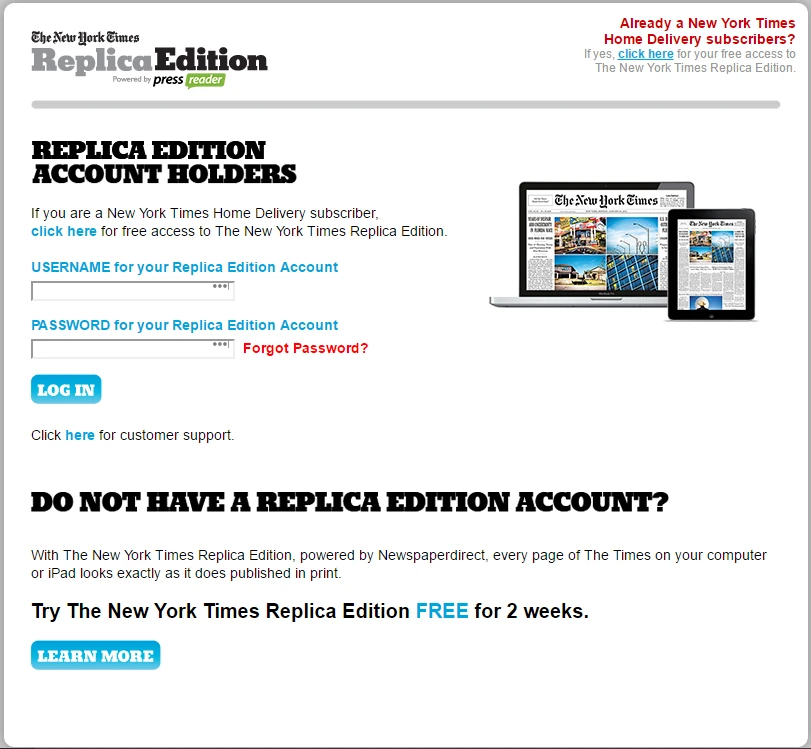
This project was a bohemeth. It took nearly a year. Here’s what I’m most proud of: I was hired by LibreDigital (the company that handled the New York Times Replica Edition) as a very junior CSS programmer. My job, at first, was to translate Photoshop designs into functioning HTML/CSS for landing pages for these replica edition sites (LibreDigital was a company partly owned by the NYT and they handled hundreds of replica editions for newspapers and magazines).
But several people left the company at an inopportune time – right before a scheduled overhaul of the New York Times backend. The sites were all built on an ancient Tomcat/Apache hosting system, with the servers physically in our building.
I was the only person left! So I took over the lead role, and we temporarily rehired the original developer of the Perl-based code. I took on both a manager/lead role as well as a full-time coding roll, and together we rewrote the entire system. This included payment gateways, user authentication, landing pages, API interfaces with the Flash based replica software, all of it. It was a mammoth project and we finally did it!
From a tech perspective, what a fascinating project! The deep and complex Perl scripting and database interactions, coupled with the relatively clunky server architecture, made it a challenge to be sure. Plus it was a high stakes project with a major client and a user base thousands strong. Credit card processing was new to me, and the user authentication part was a monster. Really great stuff if you’re into technical challenges!
Outcomes
When we finished, the NYT Replica site was way more stable, the server software was updated, and the user experience was more streamlined, uniform, and faster to respond. This project was the flagship project and once we got done, the plan was to roll out the changes to the rest of the replica edition sites. It was a success, but it was months late, which didn’t seem to matter to the NYT.
What I’d Do Differently Now
The project was late and that doesn’t sit well with me. If I had it to do over, I would take a more proactive leadership role, understanding the factors that might prevent us from meeting the arbitrary deadline, and I would have pushed to set a more realistic promise. If I had known that the New York Times was one of the owners of the company, I would have taken that into account. Overall it was a success, but I believe communication between the whole team could have been better.
In addition, the lead developer of the Flash side (the Replica display itself) worked in a silo and was resistant to working together. It took a lot to get him to share even basic information, as if we were adversaries. That made the project even slower. Today, I’m more of a people person and I would have taken more time to develop trust and a good working relationship with him early.
Finally, another department had a CSS expert who was quite a bit better than me with the nuances of CSS. Eventually she helped us quite a bit, but now I would be quicker to ask who we had around and seek her assistance. When she did contribute, things were much faster. Lesson learned: seek out players who may be better than you at given aspects of the job and recruit them early. This is the essence of leadership, something I was only beginning to learn at the time.
Oh, and I’d keep more resources in my personal folders to add to my portfolio so you could see more! Nowadays what’s up there is probably no longer my work.